
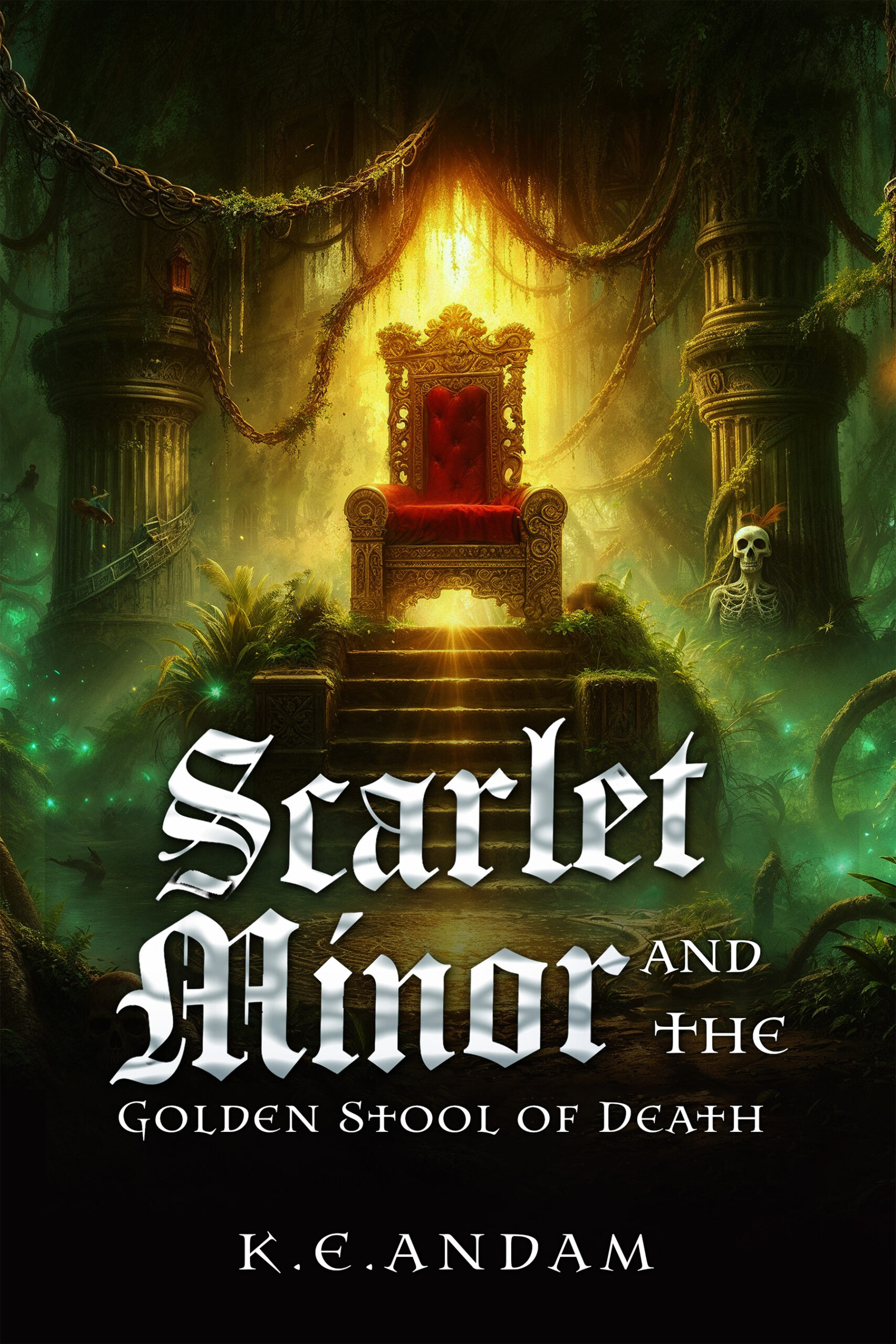
Golden Stool of Death
Word Count: 82, 109
Page Count: 306
Price range: $5.99 through $25.99
Scarlet Minor is summoned to the Ashanti capital, Asukani, when the Golden Stool—soul of the nation—vanishes without a trace. In a hall thick with fear, the king stands because he cannot sit: the sacred stool’s platform is empty. As Scarlet’s living tattoo blooms into the royal spiral, the court can’t decide whether he’s chosen or cursed. The emergency bells toll, and the empire’s shadow lengthens.
Scarlet begins to track what took the stool, guided by Koraa, a rare “Listener” who hears what others can’t. Her read is chilling: the stool wasn’t stolen by hands, but by Silence—an ancient, hungry force. Their path into Esum Adaka, the Box of Shadows, leads to a visionstone and a mute temple where Scarlet glimpses a faceless presence and understands the crisis is older than politics: it’s a war for memory itself.
Back in Asukani, imperial pressure arrives with Captain Lirien’s red-bannered warships; a siege masquerading as diplomacy. Scarlet’s allies crystallize around him: Strongy (who’s revealed to be marked like Scarlet), the scholar-seer Araya, the archer Sulo, the elder Kpaté—and, at times, the formidable Leorah. In contrast stands Ambassador Skimpy, a court powerbroker who pushes “order” even as he scents advantage in the crisis.
Seeking clarity, the group braves the Ancestor Woods to consult Bibi Naia, the exiled oracle known as the River With Teeth. Naia’s verdict reframes everything: the stool was “released,” shedding empire and corruption—it wants to be reborn. Scarlet is the “midwife,” but he’s not the only marked one; there is another who could rip the hinge off entirely. Her vision of “a city drowning in red” tightens the fuse.
The empire closes in (even the emperor’s house moves through proxies), and Skimpy maneuvers to rewrite the moment. In public ceremony, he unveils a counterfeit “true throne” and a new ideology—the Spiral Restoration—co-opting shrines, banners and even Leorah, who appears at his side as a gilded endorsement. Scarlet sees the lie: language and spectacle used to bury names. Leorah’s eyes, though, hint at bargain more than belief.
Against this creeping falsification, Scarlet pursues the older path. In the Archive of Dust he finds prophecy (“Only when the root wakes… the golden bearer kneels”) and a seed bound to the stool. Planting it on a singing hill splits the earth; roots glow and the Spiral becomes a gate. The old order’s last enforcers appear—the Versioned, obsidian wardens forged from betrayal. In a mountaintop confrontation, Scarlet briefly seats the living throne as a guardian steps aside; ancestral fire answers, the Versioned surrender to memory, and Scarlet collapses for three days. Power is real—but so is its price.
Skimpy escalates. He burns sacred groves and tries to finish the rewrite with a staff and a speech—until Scarlet brings a fragment of the true throne into the square and the city itself begins to remember. Cracks vein a monument to Skimpy’s lies; the crowd stops performing obedience and starts witnessing. Leorah turns, fighting beside Scarlet; in the end she snaps Skimpy’s staff in two. The rain that falls is ash—the ashes of old oaths and burned scrolls— settling over a people who reclaim their silenced names (the name “Efunsetan” rises like a
chorus that will not end).
Beneath the broken marble, the true stool stands—scarred, breathing, carved with an older charge: “Only memory can hold the crown.” In the book’s moral culmination, Scarlet refuses the coronation script. He does not enthrone himself, even as the spiral on his chest flowers into twelve named branches. He leaves the stool where it belongs—under sky, within community—and walks. The people do not need someone to sit; they need someone to see. The aftermath is quiet and radical. No new ruler rushes forward. Tapestries peel to reveal older patterns. Markets open softly; elders sit and listen; children trace spirals in ash. The empire’s threat remains, but the immediate victory is not of swords: it’s a returned memory. The book closes not in conquest but in rain and song—Scarlet’s legacy defined less by rule than by refusal. As the foreword frames it: he kneels, reminding us that real power is carried,and often by saying “no.”
| Book Pricing | Audiobook, Hard Cover, Soft Cover |
|---|
Related products
-
The Empires Serpents
Price range: $5.99 through $25.99 -
Scarlet Minor and the Last Atlantic Fleet
Price range: $3.99 through $21.99 -
Scarlet Minor and the Isles of Black Gold
Price range: $5.99 through $25.99

Reviews
There are no reviews yet.